Postgraduate Studentships - Search for funding opportunities.




Postgraduate Studentships - Search for funding opportunities.

 Study Details: 12 months full-time; 24 or 36 months part-time
The MSc Civil Engineering offers two options:
a general option if you’re looking to convert to civil engineering (or for those wishing to diversify/complement their existing skills)
if you have a background in civil engineering you can choose our 'sustainable pathways' route
General option
We offer a generalist MSc in Civil Engineering, to allow applicants with a degree in environmental engineering, earth science, maths, physics, and mechanical engineering to do an accredited MSc to convert to civil engineering.
The generalist MSc in Civil Engineering is also suited to those with a background in civil engineering and wishing to diversify/complement their skills.
You can select optional modules from the general Civil Engineering curriculum.
Sustainable pathways
If you have a background in civil engineering you can opt for an MSc with the following sustainable pathways:
Sustainable Structural & Geotechnical Infrastructure
Sustainable Water & Environmental Management
If you choose the pathways, you'll still apply and enrol as an MSc Civil Engineering student. Your selection will be made during induction week.
Normally, a first or upper second-class Honours degree from a UK university (or equivalent overseas qualification) in any civil engineering discipline.
Applicants with a degree in environmental engineering, maths, physics and mechanical engineering may also be considered.
Lower degree classifications might be considered if there is strength elsewhere (for example, relevant work experience, excellent final project/dissertation, very strong academic letter of reference, very strong application statement linking with career goals.)
For fees and funding options, please visit website to find out more
We work closely with the University Careers Service. They offer advice and guidance on career planning and looking for and applying for jobs. In addition, they administer and publicise graduate and work experience opportunities.
High-calibre civil engineers are in demand throughout the world. As a graduate, you'll have many different career options including:
engineering consultancies, where the work normally involves planning and designing projects
contractors, where you’ll be managing and overseeing works on-site
working for utilities or local authorities
working for large companies such as those within oil & gas production, mining, power generation, renewable energy & sustainable infrastructure
Core modules:
Group Design Project
Qualitative and Quantitative Research Methods
Optional modules:
Sustainable Ground Improvement & Reinforcement (10 credits)
Site Investigation & Risk Assessment* (10 credits)
Advanced Structural Analysis and Sustainable Design (10 credits)
Prestressed Concrete, Composite Materials & Structural Stability (10 credits)
Waste Management & Landfill Design* (10 credits)
Project Management (10 credits)
Climatic hazard to earth infrastructure (10 credits)
Contaminated Land* (10 credits)
Water & Environmental Management (10 credits)
Water & Wastewater Treatment Design* (10 credits)
Structural Health Monitoring (10 credits)
Hydrogeology (10 credits)
Advanced Materials Science for Structures (10 credits)
Global Water Policy* (10 credits)
Financial Engineering (10 credits)
Principles of Environmental Microbiology* (10 credits)
Fundamentals of Environmental Forensics* (10 credits)
Environmental Pollution Management* (10 credits)
Independent Study in Collaboration with Industry* (10 credits)
Geographical Information Systems (GIS)* (10 credits)
Design Management (10 credits)
Risk Management (10 credits)
Environmental Impact Assessment* (10 credits)
Public Health Studies (10 credits)
Information Management (10 credits)
Circular Economy & Transformations Towards Sustainability (10 credits)
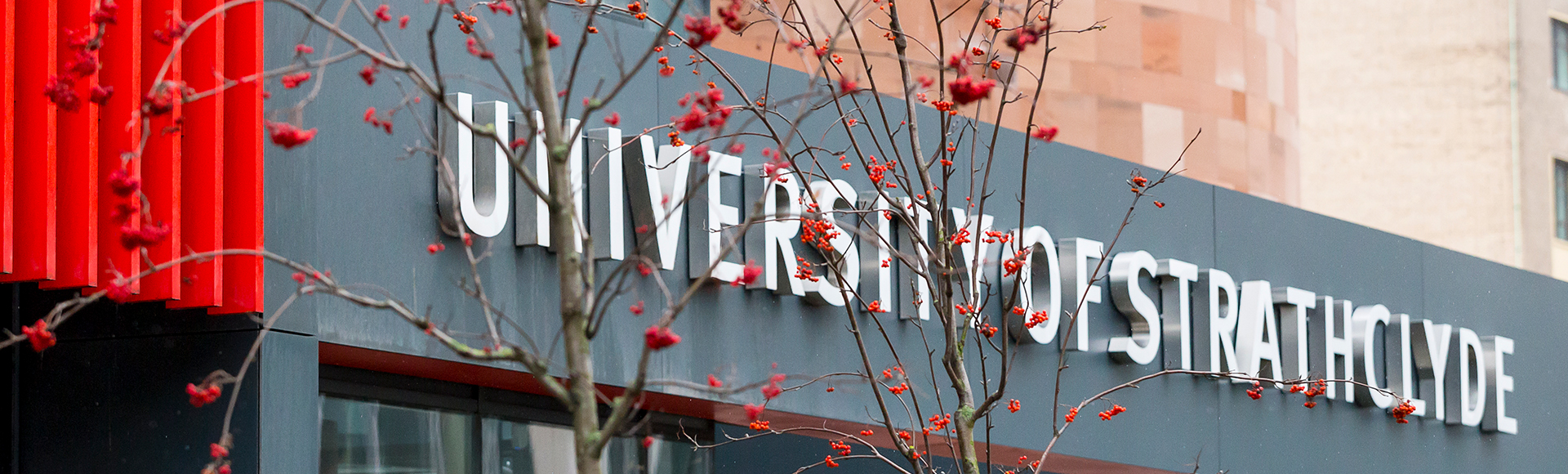
The place of useful learning The University of Strathclyde is a leading international technological university located in the heart of Glasgow – one ...