Postgraduate Studentships - Search for funding opportunities.




Postgraduate Studentships - Search for funding opportunities.
 Study Details: 2 years
The MSc Development Economics with Work Placement Year is the flagship Master's programme offered by the SOAS Economics Department.
It combines the two core intellectual traditions nurtured for decades in our unique department: a pluralist approach to economics and a focus on real-world development issues. If you are interested in understanding how the global economy works, what economic challenges and opportunities countries in the Global South face, and what to do about intensifying inequalities and ecological breakdown, this degree is for you.
In macroeconomics, you will engage with different schools of macroeconomic thought on issues like inflation, unemployment, inequality, money creation, climate change and macroeconomic policy. In microeconomics, different theoretical perspectives on issues like market failures, risk, market structures and production are compared and contrasted. In development economics, you are introduced to economic theories and policies for development through a historical, pluralist and decolonial approach.
For your placement year, you will have the opportunity to take part in a full-time, 10–12 month work placement at an organisation of your choice. Please note: you will be expected to secure the work placement yourself, to be approved by the academic department. The SOAS Careers team are on hand to help you with your CV, interview skills and finding the right organisation for you.
We will consider all applications with a 2:2 (or international equivalent) in Economics and other Social Sciences (such as Politics, Sociology, Finance, Business, International Relations, Law), as well as Mathematics, Physics, Statistics, or Engineering. Applicants with professional qualifications or relevant professional experience will also be considered. Applicants will need to demonstrate they have studied Economic theory (including Macroeconomics and Microeconomics) and ONE of the following: Mathematics, Applied Mathematics, Quantitative Methods (Statistics or Econometrics).
In addition to degree classification, we take into account other elements of the application such as supporting statement. References are optional but can help build a stronger application if you fall below the 2:2 requirement or have non-traditional qualifications.
Year 1 - Compulsory
Macroeconomics - 15 credits
Open
Microeconomics - 15 credits
Open
Growth and Development - 15 credits
Open
Econometrics with R coding - 15 credits
Open
R Coding Workshops
Open
Essay Writing Workshop - Postgraduate Economics
Open
Year 1 - Guided options - Development Economics and International Finance
60 credits from across Guided Options lists. To follow a line of specialisation of 30 credits, the remaining 30 credits should be selected from General and Regional Guided Options.
International Finance - 15 credits
Open
Financial Systems and Economic Development - 15 credits
Open
Year 1 - Guided options - Development Economics and Institutions
60 credits from across Guided Options lists. To follow a line of specialisation of 30 credits, the remaining 30 credits should be selected from General and Regional Guided Options.
Political Economy of Institutions - 15 credits
Open
Global Economic Policy Analysis - 15 credits
Open
Year 1 - Guided options - Regional
60 credits from across Guided Options lists. To follow a line of specialisation of 30 credits, the remaining 30 credits should be selected from General and Regional Guided Options.
Political Economy of Development and Change in the Middle East - 15 credits
Open
Economic development in the Asia Pacific region - 15 credits
Open
China and World Development - 15 credits
Open
Year 1 - Guided options - General
60 credits from across Guided Options lists. To follow a line of specialisation of 30 credits, the remaining 30 credits should be selected from General and Regional Guided Options.
Evaluation Methods for Economic Policy - 15 credits
Open
Research Methods - 15 credits
Open
Advanced Econometrics with R coding - 15 credits
Open
Advanced Microeconomics - 15 credits
Open
Advanced Macroeconomics - 15 credits
Open
Year 1 - Guided options - Development Economics and the Environment
60 credits from across Guided Options lists. To follow a line of specialisation of 30 credits, the remaining 30 credits should be selected from General and Regional Guided Options.
Economics of Environment and Development - 15 credits
Open
Green Finance - 15 credits
Open
Year 2 - Core
Placement Year and Dissertation
Postgraduate Placement Year - 60 credits
Open
Dissertation for MSc Development Economics - 60 credits
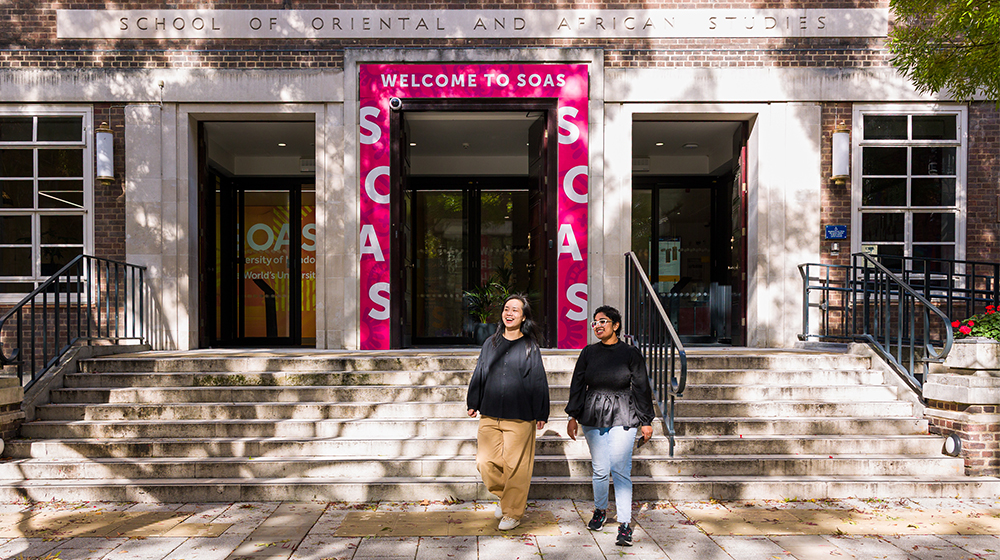
SOAS University of London is a world-leading institution for the study of Asia, Africa and the Middle East, offering a postgraduate experience t...


