Postgraduate Studentships - Search for funding opportunities.




Postgraduate Studentships - Search for funding opportunities.


 Study Details:
 MSc one year full-time, two or three years part-time
The use of energy – electricity generation, transportation, heating/cooling and industrial consumption – is the most important driver of climate change by far. Effectively addressing this urgent global challenge therefore requires transformational changes in the ways we produce, consume and govern energy. More than two decades of political contestation have shown that a supportive policy environment – meaningful and consistent domestic laws and regulation underpinned by ambitious international treaties – is the only way to affect these changes, develop alternatives to emissions-intensive fossil fuels and transition economies around the world onto a secure, low-carbon and climate-friendly footing.
The MSc addresses precisely these issues, treating climate and energy policy as inextricably linked. Cases drawn from both the Global North and South will form the basis of your studies as you examine how policy is made, advocated and implemented – or sometimes prevented – around the world. You will acquire theoretical knowledge of climate and energy policies as well as practical skills in risk analysis, policy analysis and strategic advocacy. The MSc is rounded out by negotiation and media training and a week-long study tour to key institutions in the energy and climate policy space in Brussels and Paris, such as the European Commission, various energy lobby groups, and the International Energy Agency (IEA).
We will consider all applications with 2:ii (or international equivalent) or higher. In addition to degree classification we take into account other elements of the application including supporting statement and references.
For fees and funding options please visit website to find out more
Students from SOAS’s Centre for International Studies and Diplomacy (CISD) develop an in-depth understanding of international affairs, contemporary diplomatic practice and policy-makers. Graduates leave with a portfolio of transferable skills such as critical analysis, problem solving, negotiation and communication, all of which are valued by employers across a number of sectors.
Recent graduates have been hired by:
Core
60 credits core
Dissertation in Politics and International Studies - 60 credits
Open
Compulsory
30 credits compulsory
Global Energy and Climate Policy 1 - 15 credits
Open
Global Energy and Climate Policy 2 - 15 credits
Open
Guided options List C
Students may take upto 45 credits from List C
Energy Transitions, Nature and Climate - 15 credits
Open
Environment, Governance and Development - 15 credits
Open
Water Justice: Rights, Access and Movements - 15 credits
Open
Law, Environment and Social Justice - 15 credits
Open
Law and Natural Resources 1: Framework, Rights and Land - 15 credits
Open
Law and Natural Resources 2: Biological Resources, Corporations and Mining - 15 credits
Open
Methodology in the Social Sciences - 15 credits
Open
History and Future of the United Nations - 15 credits
Open
Guided options List B
Students must take 45 credits from List B
730 Anthropology and Climate Change - 15 credits
Open
Green Finance - 15 credits
Open
Risk and Policy Analysis - 15 credits
Open
International Politics of Climate Justice - 15 credits
Open
Global Advocacy - 15 credits
Open
Global Public Policy - 15 credits
Open
Open options
Students can take a maximum of 30 credits from the School-wide open options list, including languages.
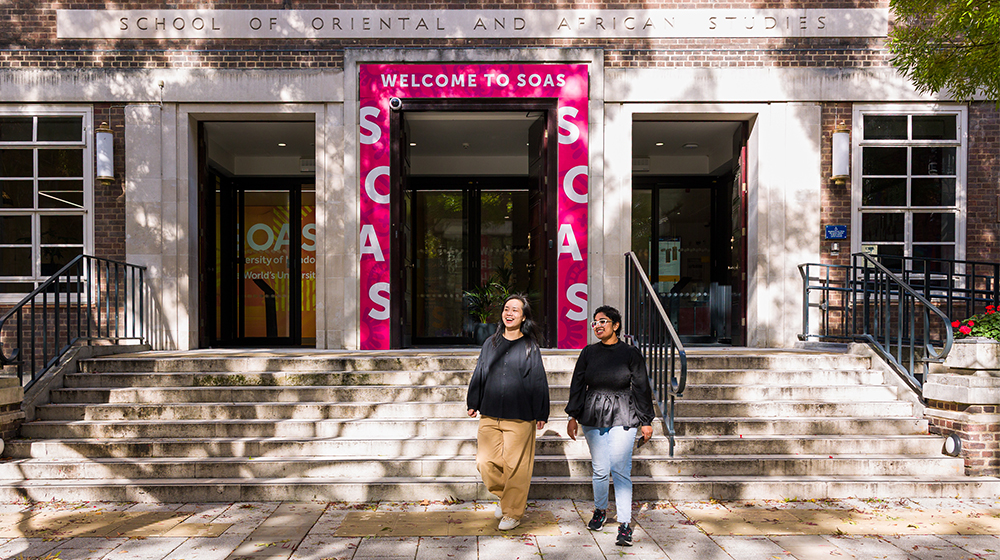
SOAS University of London is a world-leading institution for the study of Asia, Africa and the Middle East, offering a postgraduate experience t...


