Postgraduate Studentships - Search for funding opportunities.



Postgraduate Studentships - Search for funding opportunities.

 Study Details: 12 months full-time; 24 months or 36 months part-time (on campus); 36 months part-time distance learning
Our MSc Sustainability & Environmental Studies offers a cross-disciplinary approach to the study of environmental management and policy, circular economy, sustainability and Environmental Impact Assessment (EIA) in both developed and developing countries. It is suitable for applicants from all academic backgrounds and our wide range of subject options enables you to choose classes to suit your background.
You’ll learn about major environmental issues and the circular economy and gain an understanding of the methods in which environmental considerations and climate change are used in development and planning decisions. You'll be expected to probe, for example, strategies and policy options for achieving sustainable development without increasing the ecological footprint of economic activities.
A unique feature of the department is our strong link to industry and public bodies, which is an essential part of our approach to research and education. It also provides our students with valuable contacts outside the world of academia.
Normally a first-class or second-class honours degree (or international equivalent) in any degree discipline.
All backgrounds considered, including social sciences, arts, engineering, law, chemistry, maths, physics, geology, biology and business.
Lower degree classifications may be considered if there is strength elsewhere (for example, relevant work experience, excellent final project/dissertation, very strong academic letter of reference, very strong application statement linking with career goals.)
There are now more than 600 alumni from this pioneering Sustainability MSc that span the globe, contributing to environmental agencies, businesses, consultancies, NGOs and government departments.
As a graduate, you may find yourself in a range of positions in:
Private consultancies
Government agencies
Local authorities
Environmental regulators
Businesses and agencies
Some of our graduates have also created their own companies and some started a PhD after completing the MSc.
Core modules:
Circular Economy & Transformations Towards Sustainability* (10 credits)
Research methods for quantitative & qualitative approaches* (10 credits)
Environmental Impact Assessment* (10 credits)
Optional modules:
Climate Change Economics (10 credits)
Contaminated Land* (10 credits)
Economics of Inequality and Inclusive Growth* (10 credits)
Energy Economics* (10 credits)
Energy Resources & Policy (10 credits)
Environmental Economics* (10 credits)
Environmental Geochemistry* (10 credits)
Environmental Pollution Management* (10 credits)
Financial Engineering* (10 credits)
Fundamentals of Environmental Forensics* (10 credits)
Games of Strategy*(10 credits)
Geographical Information Systems (GIS)* (10 credits)
Global Water Policy* (10 credits)
Human Information Behaviour (10 credits)
Hydrogeology* (10 credits)
Independent Study in Collaboration with Industry* (10 credits)
International Environmental Law (10 credits)
Natural Resources, Sustainability & Governance (10 credits)
Organic machines, engineered environments, and hybrid natures (20 credits)
Principles of Environmental Microbiology* (10 credits)
Public Health Studies* (10 credits)
Regional Development Policy (10 credits)
Remanufacturing (10 credits)
Renewable Marine Energy Systems (10 credits)
Social Entrepreneurship (10 credits)
Sustainable Product Design and Manufacturing (10 credits)
Water & Wastewater Treatment Design* (10 credits)
Waste Management & Landfill Design* (10 credits)
Water & Environmental Management* (10 credits)
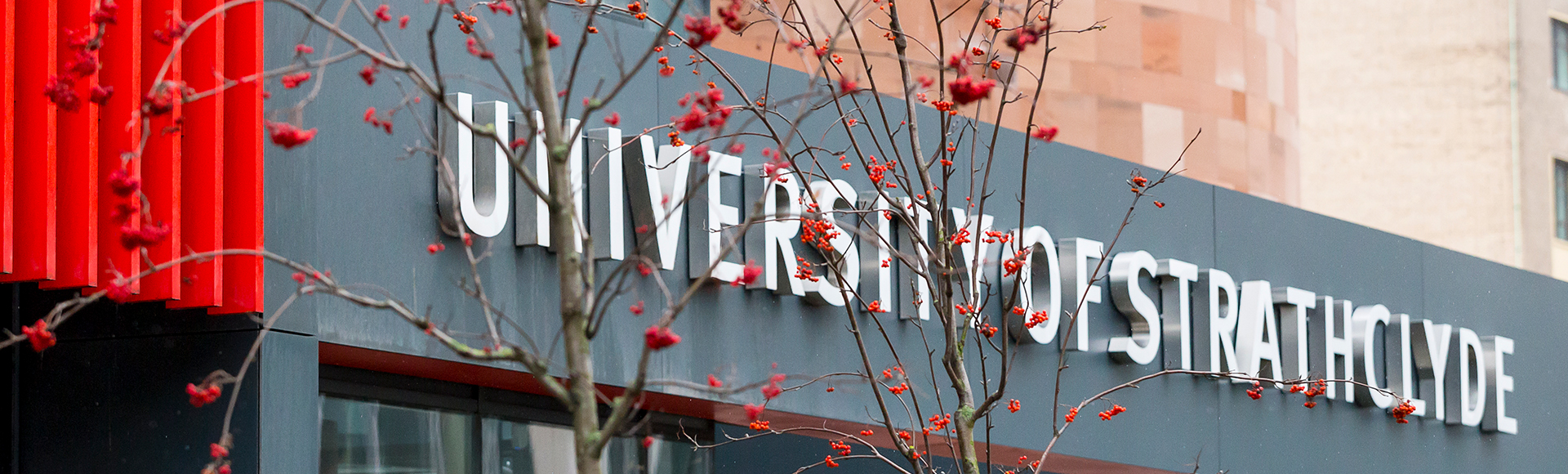
The place of useful learning The University of Strathclyde is a leading international technological university located in the heart of Glasgow – one ...


