Postgraduate Studentships - Search for funding opportunities.




Postgraduate Studentships - Search for funding opportunities.

 Study Details: 2-4 years
The MA Buddhist Studies with Intensive Language is an interdisciplinary programme that engages with Buddhism as a field of inquiry from a historical, philosophical, anthropological and material culture perspectives.
It caters to students who wish to broaden either their knowledge of Buddhism as a whole or their knowledge of specific Buddhist traditions, as well as to students intending to embark on further research or fieldwork among Buddhist communities.
This programme at SOAS follows a non-confessional, contextual approach, which highlights the diversity of Buddhism in its historical and geographical developments. The programme, crucially, appreciates Buddhism as a living religion. Detailed attention is given to how scholarship, both in the West and through Asia, has shaped our understanding of Buddhism.
The MA Buddhist Studies with Intensive Language programme benefits from teaching on Buddhist languages and regional cultures across SOAS, and is supported by the SOAS Centre of Buddhist Studies. The Centre offers extraordinary opportunities for further engagement with the study of Buddhism.
The Centre is a hub of internationally acclaimed and distinguished Buddhist scholarship that generates synergy among academics and research students, from SOAS and beyond, involved in the study of Buddhism in Asian societies. The Centre currently comprises 17 permanent members of staff and emeriti, as well as a pool of associate and graduate student members from SOAS and other UK and international institutions.
We will consider all applications with 2:2 (or international equivalent) or higher. In addition to degree classification we take into account other elements of the application such as supporting statement. References are optional, but can help build a stronger application if you fall below the 2:2 requirement or have non-traditional qualifications.
In addition to an understanding of global faiths, histories and cultures, graduates from the Department of Religions and Philosophies develop the skills to analyse and communicate ideas in a clear, rational and comprehensive manner. These key proficiencies are valuable in many careers and are transferable to a wide range of sectors and roles.Recent Department of Religions and Philosophies graduates have been hired by:
Asia Society
British Council
Cabinet Office
Chatham House
Edelman
Foreign, Commonwealth and Development Office
HELP USA
King's College Hospital NHS Foundation Trust
Princeton University
Royal Government of Cambodia
The Happiness Factory
The Inter Faith Network for the UK
The Royal Borough of Kensington and Chelsea
UNHCR, the UN Refugee Agency
United Nations Development Programme
The MA Buddhist Studies programme's structure provides a unique study pathway, characterised both by its coherence and by its flexibility. The core module "Critical Concepts in Buddhist Studies" provides students with a broad and stimulating journey into key notions and methods in the study of Buddhism.
We recommend that part-time students have between two and a half and three days free in the week to pursue their course of study.
Dissertation
Students will moreover have to submit a Dissertation in Buddhist Studies of 10,000 words, on a topic chosen from the module chosen as major. The remaining modules may be chosen in the large pool of modules on Buddhist topics and languages, thus allowing each student to build up a specialized knowledge of one or more areas of Buddhist Asia. Students are allowed to take modules taught outside the department of Religions and Philosophies up to one module, which may or may not include a language.
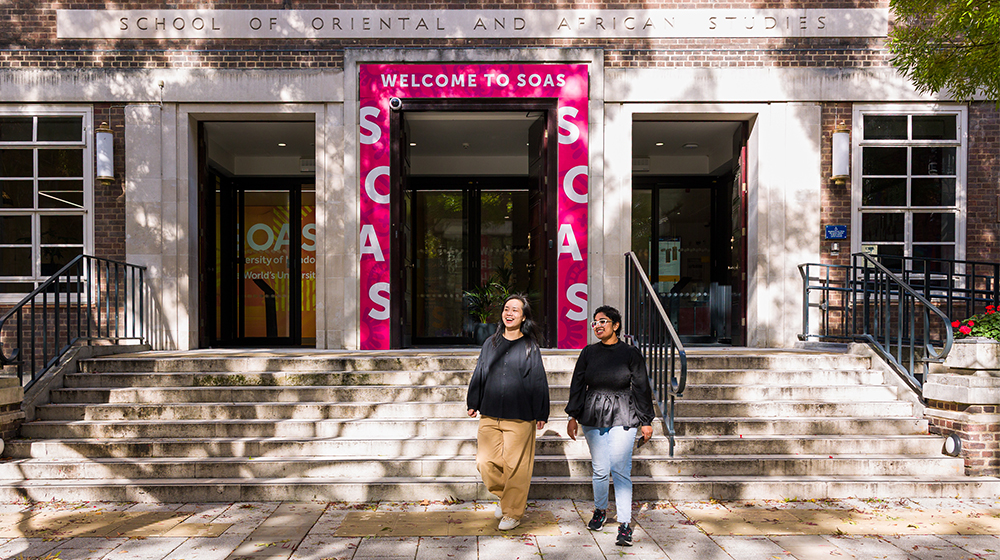
SOAS University of London is a world-leading institution for the study of Asia, Africa and the Middle East, offering a postgraduate experience t...


