Postgraduate Studentships - Search for funding opportunities.




Postgraduate Studentships - Search for funding opportunities.


 Study Details:
 MSc one year full-time, 2-3 years part-time
How will climate change affect economic policies in the Global North and the Global South? What is the future of fiscal policy and central banking? What are the economic effects of income and wealth inequality? What drives economic and financial crises? How does shadow banking affect financial stability? What is the role of game theory in economics? What are the gendered effects of recessions?
The MSc Economics equips you with the specialist knowledge that is necessary to answer these and many other questions. The programme provides unique training in both mainstream and heterodox theories and methods. It allows you to develop quantitative and qualitative skills and to apply these to a variety of contemporary economic issues.
We will consider all applications with 2: ii (or international equivalent) or higher in Economics. In addition to degree classification we take into account other elements of the application including supporting statement and references. All students must complete the Preliminary Mathematics and Statistics module which is taught over three weeks in August/September.
For fees and funding options please visit website to find out more
The SOAS MSc Economics is ideal for students who wish to obtain an in-depth pluralist understanding of economics and have the ambition to play a leading role in shaping economic policies that address global challenges. The programme provides a gateway to job opportunities in private companies, the government sector and international organisations. The advanced nature of the programme also serves as an excellent foundation for PhD studies.
Economics graduates leave SOAS with a solid grounding in statistical skills and an ability to think laterally, take a global perspective, and employ critical reasoning.
Recent graduates have been hired by:
Core
Dissertation for MSc Economics - 60 credits
Open
Compulsory
Macroeconomics - 15 credits
Open
Microeconomics - 15 credits
Open
Econometrics with R coding - 15 credits
Open
Advanced Econometrics with R coding - 15 credits
Open
R Coding Workshops
Open
Essay Writing Workshop - Postgraduate Economics
Open
Guided options - General
60 credits from across Guided Options lists. To follow a line of specialisation of 30 credits, the remaining 30 credits should be selected from General and Regional Guided Options.
Growth and Development - 15 credits
Open
Evaluation Methods for Economic Policy - 15 credits
Open
Research Methods - 15 credits
Open
Advanced Microeconomics - 15 credits
Open
Advanced Macroeconomics - 15 credits
Open
Guided options Specialism - Economics and International Finance
60 credits from across Guided Options lists. To follow a line of specialisation of 30 credits, the remaining 30 credits should be selected from General and Regional Guided Options.
International Finance - 15 credits
Open
Financial Systems and Economic Development - 15 credits
Open
Guided options Specialism - Economics and Institutions
60 credits from across Guided Options lists. To follow a line of specialisation of 30 credits, the remaining 30 credits should be selected from General and Regional Guided Options.
Political Economy of Institutions - 15 credits
Open
Global Economic Policy Analysis - 15 credits
Open
Guided options - Regional
60 credits from across Guided Options lists. To follow a line of specialisation of 30 credits, the remaining 30 credits should be selected from General and Regional Guided Options.
Political Economy of Development and Change in the Middle East - 15 credits
Open
Economic development in the Asia Pacific region - 15 credits
Open
China and World Development - 15 credits
Open
Guided options Specialism - Economics of Environment
60 credits from across Guided Options lists. To follow a line of specialisation of 30 credits, the remaining 30 credits should be selected from General and Regional Guided Options.
Economics of Environment and Development - 15 credits
Open
Green Finance - 15 credits
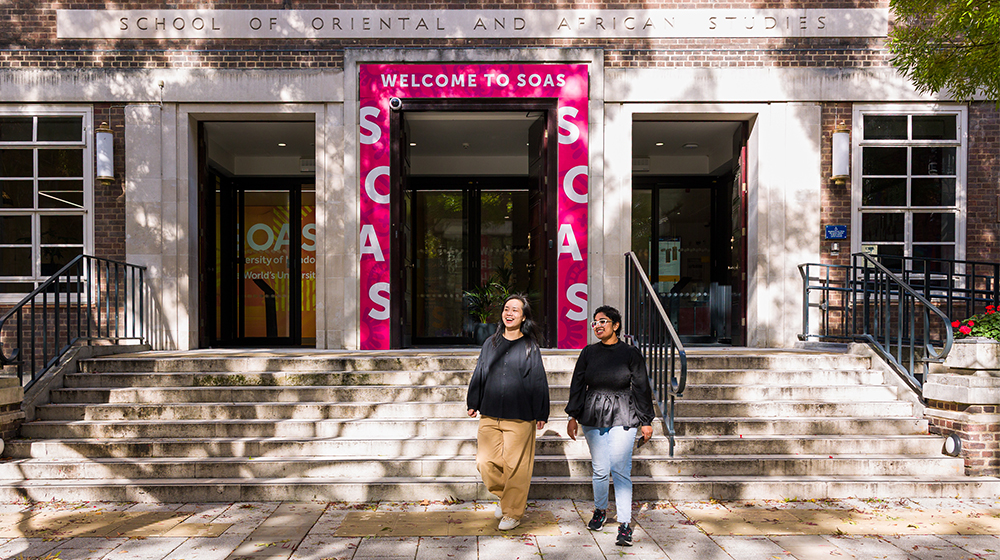
SOAS University of London is a world-leading institution for the study of Asia, Africa and the Middle East, offering a postgraduate experience t...