Postgraduate Studentships - Search for funding opportunities.




Postgraduate Studentships - Search for funding opportunities.

 Study Details: 1 Year
The MA Korean Studies is designed either to prepare the student for advanced graduate work in a wide range of subjects related to Korea, or as an end/qualification in itself.
The programme explores the history, politics, art, music and literature of Korea, as well as providing opportunities to study the languages of the region. Students in the programme come from many countries and have a wide variety of academic backgrounds. Some have already studied, or lived, in Korea and wish to broaden their knowledge or understanding.
Others wish to focus their previous training on the region, while others will come from Korea or another East Asian country wishing to study Korea from the perspective of a different culture and academic tradition. Knowledge of the Korean language is not a requirement of the programme. Language modules, however, are popular options.
We will consider all applications with 2:2 (or international equivalent) or higher. In addition to degree classification we take into account other elements of the application such as supporting statement. References are optional, but can help build a stronger application if you fall below the 2:2 requirement or have non-traditional qualifications.
Graduates from the Department of East Asian Languages and Cultures develop competencies in intercultural awareness, analysis and communication. Demand for specialists with advanced proficiency in the languages of China, Japan and Korea has significantly increased in recent years, and graduates with these skills are highly sought after by employers.
Recent graduates have been hired by organisations including:
Accenture
Amazon
Bloomberg LP
Department for Work and Pensions
European Alliance for Human Rights in North Korea
European Commission
Google
ITN
Japanese Government
Korea Trade Centre (KOTRA)
KPMG
Mizuho Bank
Nagahama Board of Education
Nanjing Museum
Pinsent Masons LLP
PwC
Seoul Metropolitan Government
Shelterbox
UNDP
Core
Dissertation in Korean Studies - 60 credits
Open
Compulsory
Connections and Intersections: Core Aspects of East Asian Studies - 15 credits
Open
Guided options List B
15-60 credits from List B
New Taiwan Cinema and Beyond (PG) - 15 credits
Open
Culture and Society of Taiwan (PG) - 15 credits
Open
Chinese for Business (PG) - 15 credits
Open
Chinese 1A (PG) - 15 credits
Open
Chinese 1B (PG) - 15 credits
Open
Ch400: Advanced Chinese (PG) - 15 credits
Open
Chinese Cinema (PG) - 15 credits
Open
Contemporary Chinese Society (PG) - 15 credits
Open
Chinese 2A (PG) - 15 credits
Open
Chinese 2B (PG) - 15 credits
Open
Chinese 3A (PG) - 15 credits
Open
Chinese 3B (PG) - 15 credits
Open
Japanese-English Translation (PG) - 15 credits
Open
Identity and social relations in Japanese (PG) - 15 credits
Open
Modernity, Nation and Identity in Japanese History (1853-1945) (PG) - 15 credits
Open
New Visions of Japan in Modern Literature and Popular Culture (PG) - 15 credits
Open
Japanese 1A (PG) - 15 credits
Open
Japanese 1B (PG) - 15 credits
Open
Korean 1A (PG) - 15 credits
Open
Korean 1B (PG) - 15 credits
Open
Myths, Legends and Folkways of East Asia (PG) - 15 credits
Open
Japanese 2A (PG) - 15 credits
Open
Japanese 2B (PG) - 15 credits
Open
Japanese 3A (PG) - 15 credits
Open
Japanese 3B (PG) - 15 credits
Open
Japanese 4A PG - 15 credits
Open
Japanese 4B PG - 15 credits
Open
Korean 2A (PG) - 15 credits
Open
Korean 2B (PG) - 15 credits
Open
Korean 3A (PG) - 15 credits
Open
Korean 3B (PG) - 15 credits
Open
Korean 4A (PG) - 15 credits
Open
Korean 4B (PG) - 15 credits
Open
Guided options List A
45-90 credits from List A
Narrative Realities in Korean Literature and Film - 15 credits
Open
The Making of Modern Korea - 15 credits
Open
Culture and Society in Traditional Korea (PG) - 15 credits
Open
Korean-English Translation (PG) - 15 credits
Open
Open options
Students can take a maximum of 60 credits from the School-wide open options list, including languages.
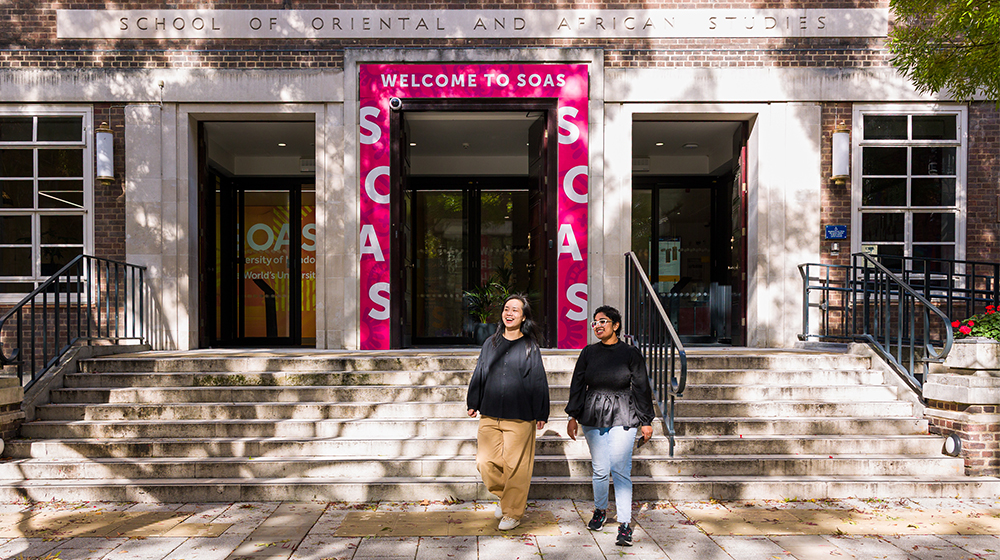
SOAS University of London is a world-leading institution for the study of Asia, Africa and the Middle East, offering a postgraduate experience t...


