Postgraduate Studentships - Search for funding opportunities.




Postgraduate Studentships - Search for funding opportunities.
 Study Details:
 MA full-time or part-time
The MA Postcolonial Studies Programme offers a focus on the historical relationships of power, domination and practices of imperialism and colonialism in the modern period (late nineteenth-century to the present) through the study of literature and culture.
The core module will introduce a variety of theoretical and methodological approaches to the literature, film and media of these areas. A range of literary, filmic and theoretical texts from Africa, Asia, the Caribbean and the Near and Middle East will normally be included in the reading list. These will address representations of colonialism and decolonisation, neo-colonialism, nationalism in postcolonial societies and diasporic experiences, allowing us to explore the heterogeneous meanings, intersections and strategies of analysis that have emerged with reference to postcolonial studies.
We will consider all applications with 2:ii (or international equivalent) or higher. In addition to degree classification we take into account other elements of the application including supporting statement and references.
For fees and funding options please visit website to find out more
Graduates of the School of Languages, Cultures and Linguistics leave SOAS not only with linguistic and cultural expertise, but also with skills in written and oral communication, analysis and problem solving.
Recent graduates have been hired by:
Africa Matters
Amnesty International
Arab British Chamber of Commerce
BBC World Service
British High Commission
Council for British Research in the Levant
Department for International Development
Edelman
Embassy of Jordan
Ernst & Young
Foreign & Commonwealth Office
Google
Institute of Arab and Islamic Studies
Middle East Eye
Saïd Foundation
TalkAbout Speech Therapy
The Black Curriculum
The Telegraph
United Nations Development Programme
UNHCR, the UN Refugee Agency
Wall Street Journal
Core
Dissertation in Cultural, Literary, and Postcolonial Studies - 60 credits
Open
Compulsory
Postcolonial Critical Thought - 15 credits
Open
Decolonial Practices - 15 credits
Open
Guided options
Students must take a minimum of 60 credits from List A and upto a Maximum of 90 credits
Core Themes and Debates in African Philosophy - 15 credits
Open
Intersecting Worlds: Race and Gender in the Contemporary Postcolonial Novel - 15 credits
Open
Contemporary African Literature (PG) - 15 credits
Open
Language, Identity and Society in Africa (PG) - 15 credits
Open
750A Ethnographic Locations: Sub-Saharan Africa - 15 credits
Open
725 African and Asian Diasporas: Culture, Politics, Identities - 15 credits
Open
724 Migration, Borders and Space: Decolonial Approaches - 15 credits
Open
Art and Politics in Africa - 15 credits
Open
Global Film Industries - 15 credits
Open
New Taiwan Cinema and Beyond (PG) - 15 credits
Open
Culture and Society of Taiwan (PG) - 15 credits
Open
World Literature (PG) - 15 credits
Open
Cultural Studies: Origins, Ideas and New Approaches - 15 credits
Open
Comparative Literature: Methodology and Critique - 15 credits
Open
Comparative Literature: A New Era - 15 credits
Open
Cultural Studies: New Practices and Widening Horizons - 15 credits
Open
Gender and Development - 15 credits
Open
Borders and Development - 15 credits
Open
Aid and Development - 15 credits
Open
Migration and Policy - 15 credits
Open
Labour, Activism and Global Development - 15 credits
Open
Feminist Political Economy and Global Development - 15 credits
Open
Political Economy of Development and Change in the Middle East - 15 credits
Open
Economic development in the Asia Pacific region - 15 credits
Open
Queering Migrations and Diasporas - 15 credits
Open
Queer Politics in Asia, Africa and the Middle East - 15 credits
Open
Gender Theory and the Study of Asia, Africa and the Middle East 1 - 15 credits
Open
Gender Theory and the Study of Asia, Africa and the Middle East 2 - 15 credits
Open
Gender, Race and History - 15 credits
Open
Community, Religion, and Conflict in South Asian History - 15 credits
Open
The Afghanistan Wars, 1979 to the Present - 15 credits
Open
Narrative Realities in Korean Literature and Film - 15 credits
Open
Translating Cultures - 15 credits
Open
New Visions of Japan in Modern Literature and Popular Culture (PG) - 15 credits
Open
The Making of Modern Korea - 15 credits
Open
Colonialism, Empire and International Law - 15 credits
Open
Law and Society in Southeast Asia - 15 credits
Open
Law and Development in Africa I: Theories and Concepts - 15 credits
Open
Law and Development in Africa II: Thematic Topics - 15 credits
Open
Transnational Communities and Diasporic Media:Networking, Connectivity, Identity - 15 credits
Open
Topics in Global Media and Digital Communication - 15 credits
Open
Prejudice, Conspiracy and Misinformation: Understanding the Debate around '(Post)-Truth' - 15 credits
Open
Music, Exile and Diaspora: the Jews of Arab Lands - 15 credits
Open
Music in Global Perspective - 15 credits
Open
Modern Palestinian Literature (PG) - 15 credits
Open
Palestine, History, Culture, Politics - 15 credits
Open
From Palestine to Israel - 15 credits
Open
Violence, Justice and the Politics of Memory - 15 credits
Open
Political Theory, Race and Empire - 15 credits
Open
South Asian Cinema and the Diaspora (MA) - 15 credits
Open
Politics of Culture in Contemporary South Asia - 15 credits
Open
Literatures of Resistance in South Asia (PG) - 15 credits
Open
War, Revolution and Independence in South East Asia Literatures in Translation (Masters) - 15 credits
Open
Genders and Sexualities in South East Asian Film - 15 credits
Open
Muslim Britain: Perspectives and Realities - 15 credits
Open
Religion and Global Politics: Themes and Critical Perspectives - 15 credits
Open
Religion and Global Politics: Theories and Genealogies - 15 credits
Open
Open options
Students can take a maximum of 30 credits from the School-wide open options list, including languages.
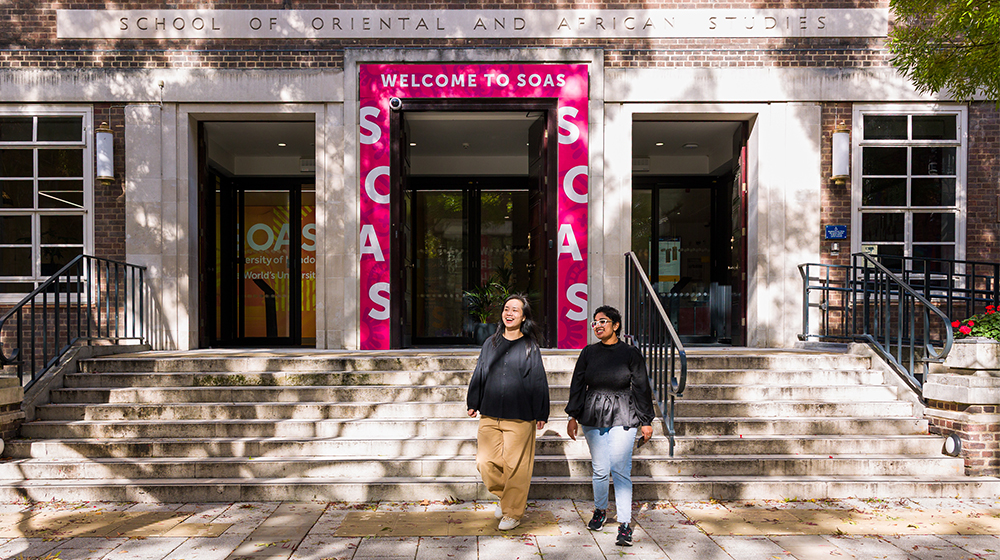
SOAS University of London is a world-leading institution for the study of Asia, Africa and the Middle East, offering a postgraduate experience t...


