Postgraduate Studentships - Search for funding opportunities.



Postgraduate Studentships - Search for funding opportunities.


 Study Details: 1-5 Years
Religion remains a force to be reckoned with in the contemporary global geopolitical landscape.
As a result, there is a pressing need to reassess predominant understandings of secularisation, as well as the meanings of, and tensions inherent within, secular assumptions and secularist positions. The so-called 'resurgence' of religion in the public sphere in recent decades is now a significant area of interdisciplinary scholarship eliciting a complex array of responses, ranging from vehement opposition to the very idea that religious concepts and commitments have a right to expression in political debates, to a reassessment of the origins and implications of divisions between the secular and the religious and their relationship to the nation state.
The notion that there is no singular secularism, but rather a plurality of secularisms, and of ‘religion’ as an invention of European modernity and colonial interests are two of many emerging efforts to re-conceptualise the meanings of religion and the secular and the entangled relationship between them.
SOAS’s MA Religion, Politics, and Society programme offers a unique and intellectually rich opportunity to examine these questions and issues at an advanced and interdisciplinary level by studying the complex relationships between religion and politics in the histories and contemporary political contexts (both national and international) of Asia, Africa and the Middle East.
A core, decolonial objective is to actively challenge the Eurocentrism of current debates around secularism, secularisation, the nature of the public sphere within modernity, by drawing substantive attention to the plurality and contested nature of conceptions of both religion and the secular when considered in a global framework. The programme is designed to appeal to policy-makers, analysts, journalists and researchers in either international, national or regional institutions and organisations engaged in policy formation, inter-religious dialogue and community development, social work, development, conflict resolution, peace building or diversity management.
We will consider all applications with 2:2 (or international equivalent) or higher. In addition to degree classification we take into account other elements of the application such as supporting statement. References are optional, but can help build a stronger application if you fall below the 2:2 requirement or have non-traditional qualifications.
In addition to an understanding of global faiths, histories and cultures, graduates from the Department of Religions and Philosophies develop the skills to analyse and communicate ideas in a clear, rational and comprehensive manner. These key proficiencies are valuable in many careers and are transferable to a wide range of sectors and roles.
Use our combined courses tool to see a breakdown of course structure
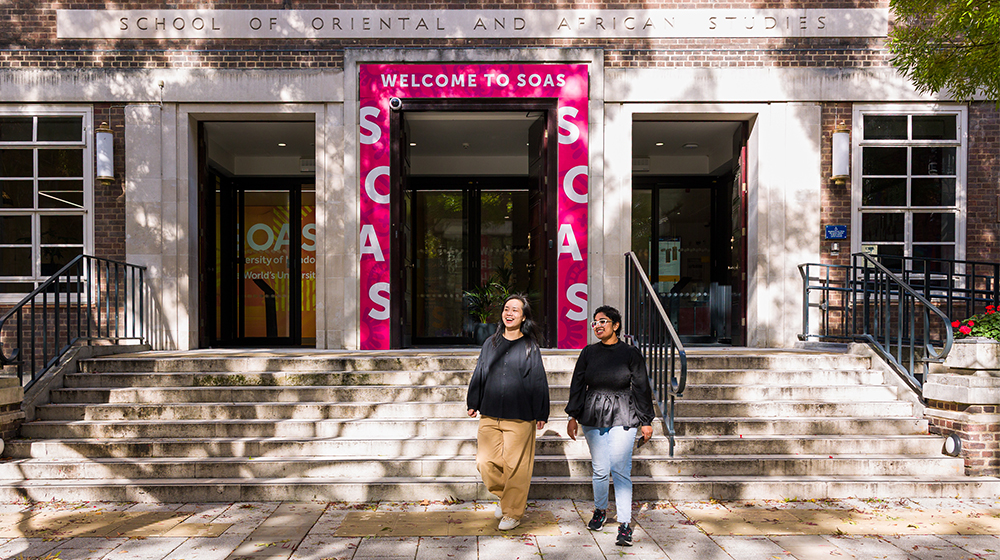
SOAS University of London is a world-leading institution for the study of Asia, Africa and the Middle East, offering a postgraduate experience t...