Postgraduate Studentships - Search for funding opportunities.



Postgraduate Studentships - Search for funding opportunities.



 Study Details: Full time 1 - 2 years, Part time 1 - 2 years
Our world faces many environmental challenges, whether with ongoing climate change, biodiversity loss, uncertain food security, natural hazards, or pollution. We need a new generation to understand the urgency of the problem and guide us on a more sustainable trajectory.
With the MSc Environmental Sustainability, you will gain knowledge and first-hand experience of key environmental sustainability challenges, such as the energy transition, food production, flooding, and conservation. You will learn their broader social context, how they are defined and monitored and what solutions can be implemented at a local level. Taught by our world-leading experts, you will discover how both problems and solutions can be scaled up from the local to the global and so unlock the potential to seed transformative change. The skills you will gain match those being sought by a growing number of employers across the public and private sectors and will equip you to make a difference.
For recent graduates or professionals who want to gain expert knowledge and understanding of sustainability, who want to show leadership in protecting and restoring our environment, and who want to progress their career and their passion for improving livelihoods.
This programme will provide training in techniques such as sustainability assessment, carbon accounting, institutional analysis, systems thinking and policy evaluation. Throughout this degree, you will also:
You will develop your own specialist subject knowledge and skills in relation to the meaning, interpretation and application of sustainability concepts in different local, national and international contexts.
Through a series of core and optional modules, you will explore alternative theories and perspectives of environmental sustainability. By engaging in constructive debates, assessing policies and evaluating the success of new initiatives in relation to climate, energy, water, land for example, you will develop a deep and critical understanding of the field.
Thanks to Lancaster’s surroundings, including the Lake District, there is a rich variety of environmental case studies on our doorstep. This means you will gain first-hand experience of ongoing environmental sustainability controversies, challenges and initiatives. Examples include lake pollution at Windermere, habitat restoration and rewilding initiatives, the energy transition from coal mines to renewables and innovative waste management schemes.
Study alongside work and other commitments by taking this course on a part-time basis. Running over two years, you take a selection of the modules each year.
We will liaise with you over your choice of optional modules and your schedule, so that you can successfully balance your work and other commitments alongside the Master’s programme.
2:2 Hons degree (UK or equivalent) in a subject with a component of Natural or Physical Sciences, e.g. Environmental Science, Physics, Chemistry, Biology, Geography, Ecology or similar.
We may also consider non-standard applicants, for example where the degree subject does not include a component of Natural or Physical Sciences, but the applicant has considerable work experience or similar training related to Environmental Sustainabaility. Please contact us for information.
Graduates of the MSc Environmental Sustainability will be open to career opportunities in a wide variety of fields, including professional roles in:
Roles may include:
Core
Eco-innovation for Sustainable Development
Global Perspectives on Environmental Sustainability
Local Environmental Challenges and Initiatives
Master's Dissertation
Optional
Agriculture, Climate Change and Food Security
Applied Data Science for Biodiversity
Environmental Governance and Management
Environmental Impact Assessment
Geoinformatics
Managing the Energy Transition
Perspectives on Environment and Development
Understanding Climate Society
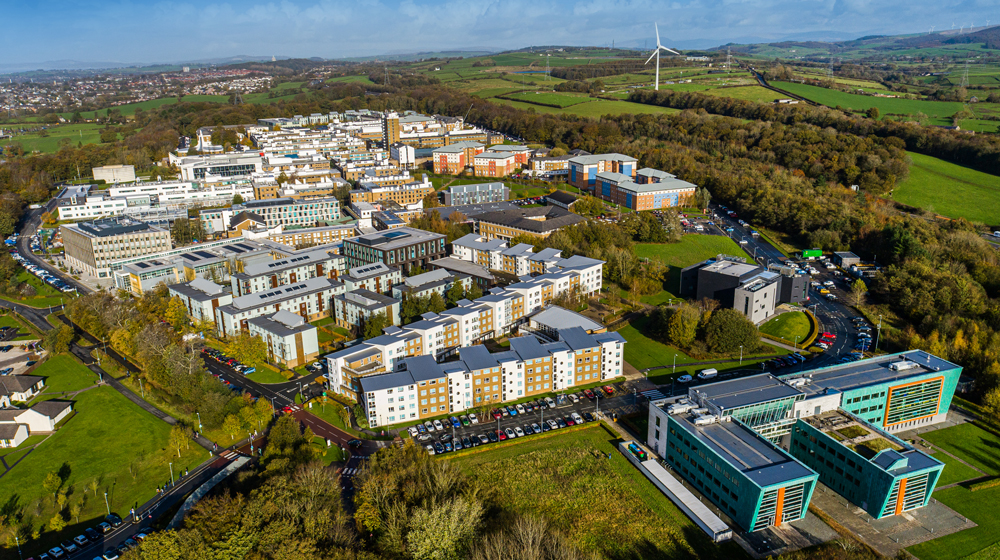
Global reputation and research excellence Lancaster is a top 10 UK university (Complete University Guide 2026) set on a 578‑acre parkland campus in n...


 Sat 27 Jun 2026